

case study
Pit Viper
Pit Viper makes sunglasses for people who think Oakley takes itself too seriously. Neon frames, absurd marketing, a cult following built on not caring what the eyewear industry thinks.
Their brand voice was already strong on Instagram and TikTok. YouTube was the gap. A channel existed, but it was running on ads, launch films and influencer drops, with no consistent short-form engine behind it.
Between January and late February 2026 the channel pulled 676,100 views, almost entirely paid, and finished the period 51 subscribers down.
Why did they come to Content Forge?
Pit Viper didn't need content strategists brainstorming “brand-aligned content pillars” in a conference room. They needed people who'd actually wear Pit Vipers while building a raft, and then film it.
Their internal team was busy with product drops and retail. They wanted a crew that could post consistently without anyone at Pit Viper babysitting the process. They were also curious about international reach through Spanish dubbing.
How We Helped
We cast two creators onto the account. These two don't play characters. They actually build things, race things, and compete against each other in increasingly stupid challenges. All while wearing Pit Vipers, obviously.
We developed four content formats: Universal Style (everyday stunts), DIY (building absurd things), Day-X Challenge Series (multi-episode learning arcs), and Challenge Accepted (the two of them head-to-head).
Strategy ran on a weekly cadence with a structured review pipeline behind it. A third creator joined the roster in May 2026.
The brand-studio setup runs at 20 to 40 original videos a month with a dedicated editing team behind it, which let us hold a cadence of five videos a week through the first three months. We've also cut four ads from the organic library, though that stays deliberately secondary: Pit Viper don't want us drifting off organic.
The angle mattered more than the volume. Because they were only ever posting product films, we needed content that would pull viewers in whether or not they cared about sunglasses: sports, camaraderie, group challenges, and a healthy amount of the absurd.

The First 3 Months
The creators shot a full slate on a single Montana trip, and the review queue was stacked inside the first week.
The breakthrough came from our analytics reports: retention curves, Stayed-to-Watch, and APV for every upload. The data was clear: relatable, everyday-scenario videos crushed pure stunt content. A video about ski resort burger prices outperformed the big production pieces. That changed the content calendar: less spectacle, more “hey, I've been in that exact situation.”
Our First Viral Video
The ski resort burger video took the overwhelming majority of engaged views during its peak period. One video was doing almost all the work for the entire channel.
It lifted the channel's daily baseline while it ran, and when it faded the baseline stayed up. That's not a viral spike. That's a content strategy compounding.
It arrived about two weeks after launch, and it was a surprise in one specific way: the format was one that normally lives on Instagram and TikTok. It converted on YouTube because the content was relatable, and when we syndicated it back to Instagram it performed there too.
Results
YouTube
- 15M views in the last three months.
- 500K+ views on the current top video.
- 34.3K subscribers on the channel today.
Growth
- From a channel losing subscribers to five videos a week.
- Expanded from 2 creators to 3.
- Brand search interest up 10% year on year, climbing through the spring as output scaled (Google Trends, US).
- Pit Viper now syndicating our content as trial reels on Instagram.
Brand search climbed through the spring as output scaled, and finished the year up 10% on the one before it.
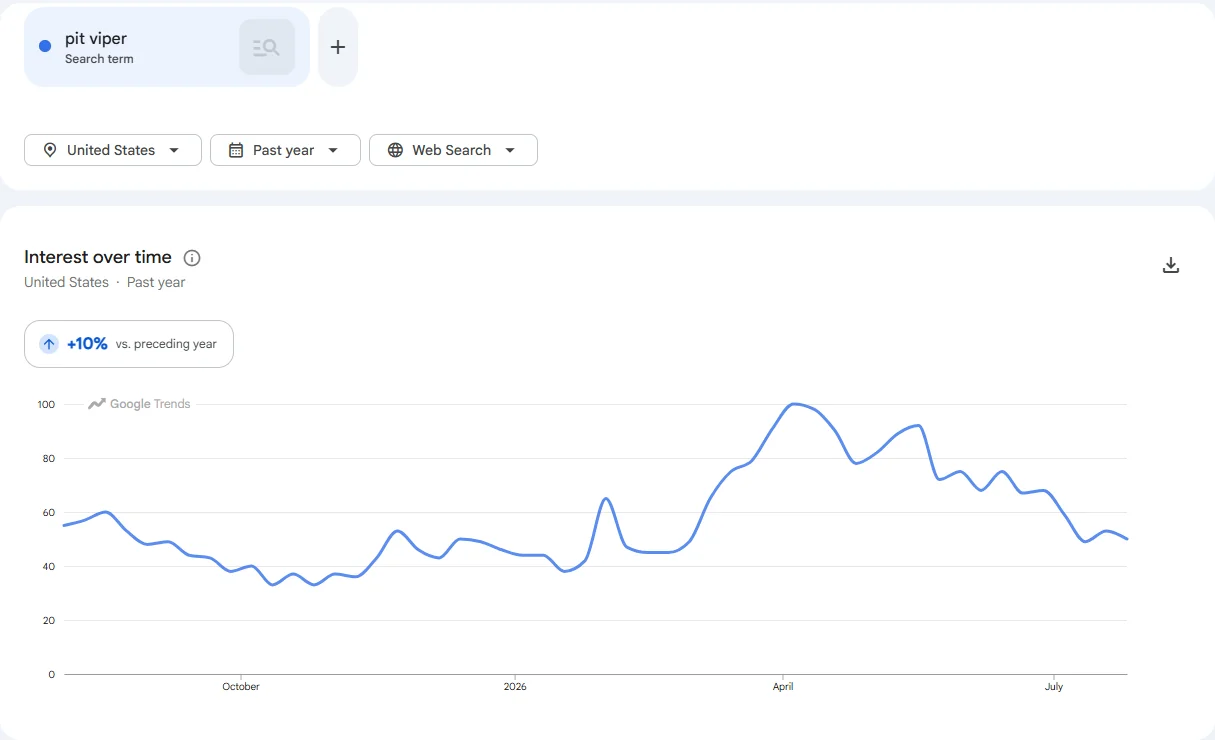 Google Trends, “pit viper”, US
What our clients have to say
“Content Forge just gets it. Great work, fast turnaround, zero hand-holding needed. Our channel has never looked better. Highly recommend.”

Chris Garcin
CEO & Co-Founder, Pit Viper